The destroyed Chessie System bridge over the Black Fork just east of Parsons following the historic 1985 flood. Credit: Photo courtesy of Tucker Culture
ELKINS, W.Va. – Nearly 40 years later, the memories of the 1985 flood still sit vividly in the minds of West Virginians who lived through it.
Amy Moore, who grew up in Parsons and lived there during the Election Day Floods, said she recalls that day like it was yesterday.
“It had been raining, and my dad came home from work and said the streets were flooding in town, which was kind of normal because of drainage problems,” Moore said. “As the water continued to rise, it was around my hips at this point. I started seeing things float by. I saw a house, I saw cows, cars, I saw everything.”
In total, 38 people died in West Virginia from the floods and cost the state roughly $700 million in damages.
Many cattle from farms upstream were washed away during the 1985 flood. This photo was taken from a canoe at the bridge in St. George. Credit: Photo courtesy of Tucker Culture
Moore’s experience was one of countless stories from the 1985 flood, an event that devastated communities across northern and eastern West Virginia. It was considered a rare 100-year flood at the time, the kind that happens only once in a lifetime. The state has since experienced several major flooding events like it in the decades that followed.
West Virginia has seen major flooding again and again: in 1996, 2001, 2016, 2023 and again this past summer, where intense rainfall overwhelmed drainage systems and turned roads into rivers in areas such as Marion and Ohio county.
But new climate data suggest the floods happening now are not the same as those in the past and are becoming more frequent.
Nicholas Zegre, a professor of forest hydrology and the director of the mountain hydrology lab at West Virginia University, says the state is becoming both wetter and drier simultaneously, a recipe for newer, more severe precipitation patterns.
“The warmer the air temperature, the (more the) atmosphere expands, the greater the ability for the atmosphere to store water. And so with the increased evaporation from the land surface, there's more water going into the atmosphere, and more water can be stored,” Zegre said. “So when rainfall does happen, the rainfall is heavier and more extreme. And so what we're seeing throughout Appalachia, in many parts across the globe, is with a warming atmosphere.”
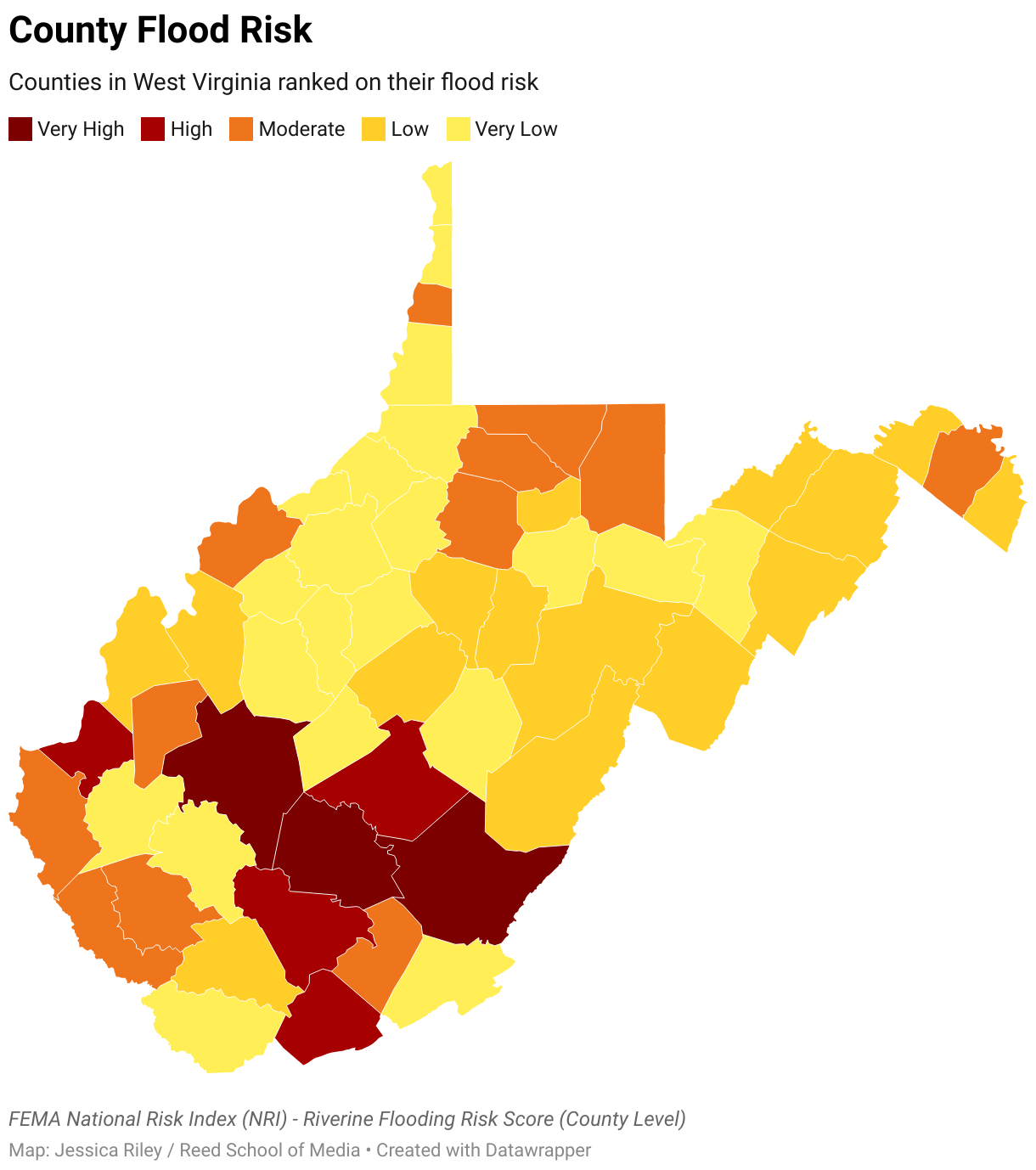
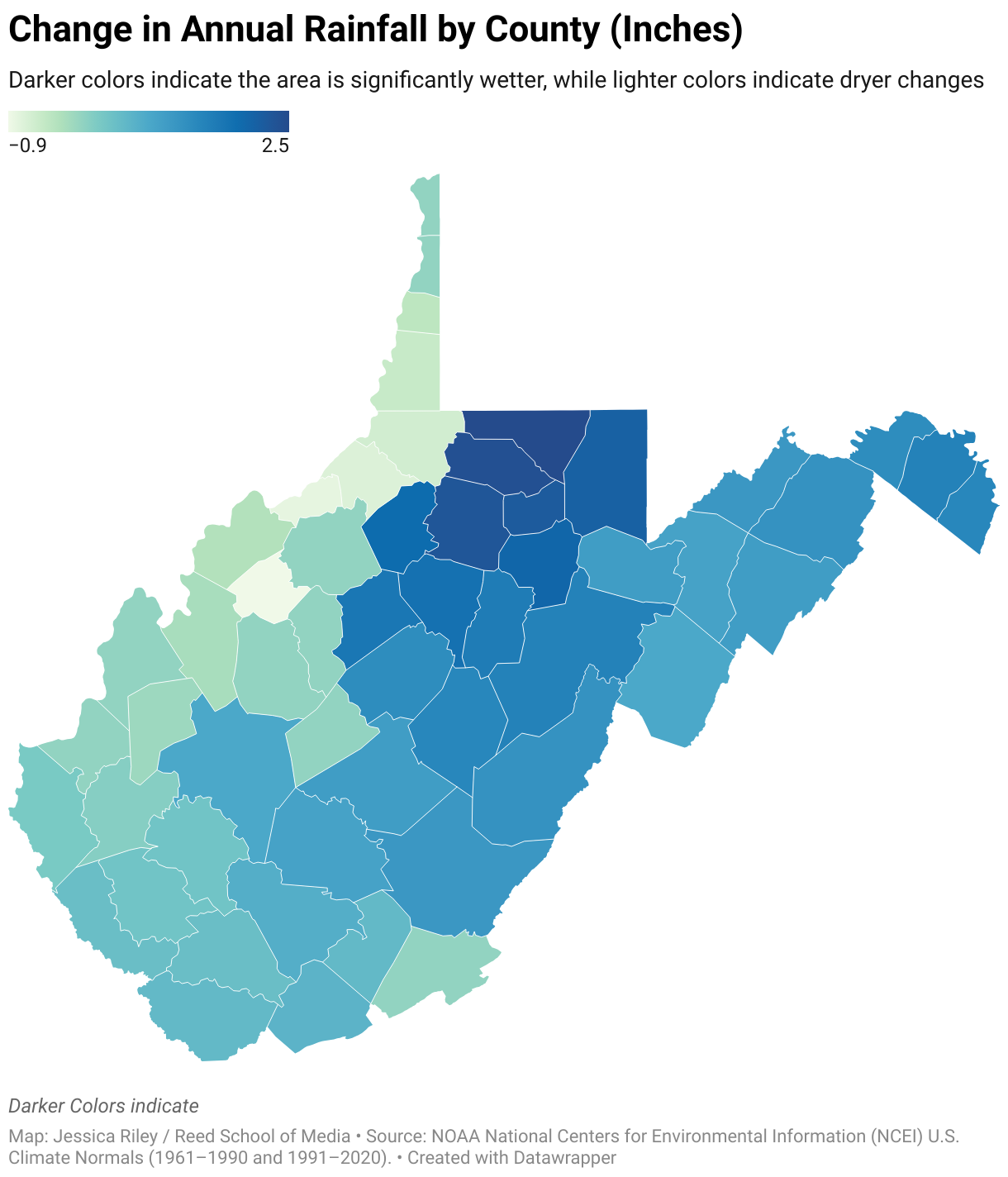
Parts of the year, the atmosphere is getting drier due to lack of precipitation, and when it does occur, it is heavier and more extreme, Zegre explained.
According to the Climate Link, the amount of rainfall that happens within the first hour of a storm has increased by about 30% during the past 30 years, which has led to more frequent and extreme floods.
According to the Community Risk Assessment Report, West Virginia faces some of the highest flood vulnerability in the nation, with 94% of its 286 communities at significant risk. Repeated flooding can overwhelm a community’s ability to recover, especially in places already dealing with major socio-economic challenges.
Graph showing annual participation across WV from 1900-2025. Credit: Courtesy of NOAA
But increased rainfall due to a warming climate is not the only issue causing major floods in West Virginia. Infrastructure across the state was originally designed for these events to occur in the 19th and 20th century, not current climate events and has now become outdated.
“As the climate changes, and as fast as it's changing, it's impossible for the infrastructure designed to keep up with those changes,” Zegre said. “Not only is our infrastructure undersized for the kind of rainfall that we are receiving and projected to receive in the future, our residents and our buildings and our businesses and our infrastructure are all along rivers. And so this creates a threat multiplier in the sense of vulnerability to floods.”
West Virginia has about 32,260 miles of rivers and roughly 40,000 stream miles, with most of the state’s urbanized areas being concentrated along major rivers like the Ohio, Kanawha and Monongahela.
With the sheer amount of outdated infrastructure, replacing or building new infrastructure across the entire state would cost billions of dollars, combined with recent slashes to federal funding regarding flood resilience – According to Zegre, West Virginians must rely on other ways to be more flood resilient.
“A lot of the work that we do in the mountain hydrology lab is working with communities to become more flood resilient, meaning we know the heavy rainfall and the floods are going to increase there,” Zegre said. “So far as the atmosphere is warming, so far as climate change is happening, rainfall and floods are going to [increase]. We know we can't stop the rain and the floods, the water moving down our mountain slopes. So what can we do?”
Zegre says knowing how to act and prepare for a flooding event is one part of the solution, even if it is unknown if or when a flood will occur. According to Zegre’s research, this means knowing where to go, how to protect your property and having resources in place – such as flood insurance – for when a flood does happen.
“What we're seeing from the federal government is divestment in states, not investment,” Zegre said. “Under the current administration, they're giving less money to states, and so the infrastructure problem will remain, but what we can do is work with communities to prepare and adapt to increases in flooding.”
Travis Blosser, City Manager of Fairmont, West Virignia. Credit: Courtesy of FairmontWV.gov
Fairmont City Manager Travis Blosser says outdated infrastructure played a major role in flooding in his city on June 15-16 this year.
“The learning experience from that is that, yes, there are areas inside the city that were not designed to deal with that amount of rainfall in that short of time period. There are several areas that we have honed in on that need to see some additional infrastructure, which that's going to cost money, and so it's figuring out where those resources are coming from to be able to mitigate those issues,” Blosser said.
As Zegre explained, floods that once seemed rare are becoming more frequent as increased atmospheric moisture brings heavier rainfall, raising the likelihood of annual flooding in some communities
“[June] was a once in a 1,000 year flood event. The problem is that doesn't mean that you're not going to have another one until another 1,000 years from now. We're seeing these events more and more often,” Blosser said.
Lack of agreement
Beyond infrastructure and rainfall, flood resilience is also shaped by whether communities believe in the causes of the problem at all. Deep divisions over climate change and distrust in institutions can limit public support for adaptation efforts, even as flooding worsens across the state.
“Climate change has become a very controversial topic for lots of different reasons, but when we engage with adults throughout West Virginia, half of that population denies climate change is happening or that it poses a problem for them,” Zegre said. “But, when we have that same conversation with youth and young adults in the state, they say climate change is happening and poses a threat to them and the world they are going to inherit from older generations as they grow up.”
Zegre says his research points to climate change as the cause of increased severe weather events, but in many West Virginia communities, conversations with affected people shut down at the mention of the topic. Instead, Zegre says, he focuses his conversations on people’s real life experiences.
“When you ask people throughout West Virginia about their experiences, what they say is, yes, the rain is getting heavier when it rains. And yes, it seems to be happening more frequently. And yes, it seems like this creek that flows through my property that we have lived in for six generations, never flooded like this. And so when we sidestep the conversation around climate change and really focus on what people are experiencing resoundingly throughout the state, people say, Yes, something has changed, and it's becoming more intense,” Zegre said.
Blosser says despite disagreements about causes, he has seen firsthand West Virginia communities still come together to support each other in the wake of disaster.
A bridge collapse at the Crossing Mall in Elkview stranded many locals in June 2016 during historic flooding in southern West Virginia. Credit: Kara Lofton, photo courtesy of West Virginia Public Broadcasting
“I was impressed and amazed by the response of our community, but even more so people outside our community that poured in with support, and not just the city of Fairmont. So I mean, I think my biggest takeaway from the entire experience is, number one, we have amazing emergency service personnel and we have an amazing community that responds in times of need,” Blosser said.Moore says generations later, that has not changed. In 1985, she experienced the same level of community support.
“I think community always helps, especially in West Virginia, because that is just who West Virginians are. They are people who help each other in times of need. Always,” Moore said.
As of now, there are no major plans in place to update or build any new infrastructure across West Virginia.